Been Hip-Hop Since ’83
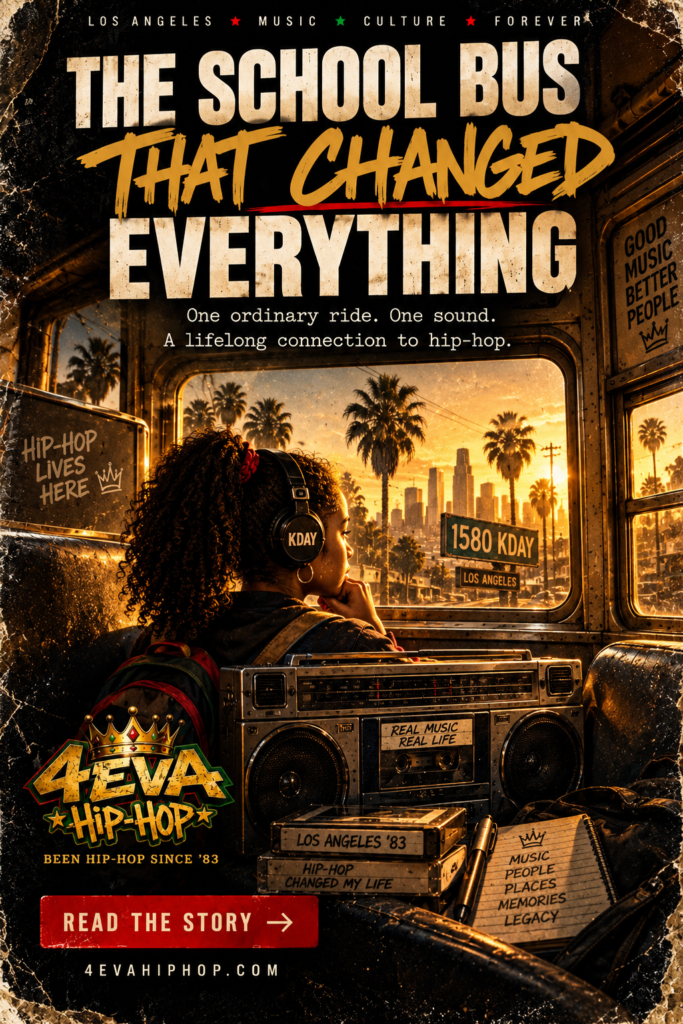
The school bus lurched around a corner, its metal frame rattling and groaning as sunlight flickered across the rows of vinyl seats. Kids shouted over one another, backpacks swung through the aisle, and the smell of diesel drifted through the open windows. It was just another Southern California school morning — until a burst of sound crackled from a small radio tuned to 1580 KDAY.
The beat punched through the noise of the bus. The voices carried a rhythm I’d never heard before. For a moment everything else faded, and I leaned in.
I didn’t know the name of the music. I didn’t know I was hearing the early pulse of a culture that would change the world. But sitting there on that bouncing seat, I felt something shift — and without realizing it, I had stumbled into a lifelong relationship with hip hop.
The first time I heard hip hop wasn’t in a club. It wasn’t at a concert. It wasn’t a friend handing me a mixtape. It was riding a school bus in Southern California.
Back then there were no streaming services, no playlists, no algorithms deciding what you might like. If you wanted to discover something, you listened to the radio. For me, that radio was 1580 KDAY — and long before anyone called hip hop a global phenomenon, KDAY was introducing a generation of kids to a sound unlike anything we’d heard. The station became our soundtrack, our teacher, and our connection to a culture still finding its place in the world.
Every ride became a chance to hear something new. I’d sit there listening close, hoping my song would come on before my stop. There was no replay button. If you missed it, you missed it. That scarcity made every moment matter.
I can still remember hearing The Sugarhill Gang, Run-D.M.C., Grandmaster Flash & The Furious Five. At the time I didn’t know I was listening to history. I just knew the music made me feel something the rest of the dial didn’t.
The beats were different. The energy was different. The attitude was different. This wasn’t the polished sound dominating mainstream radio — nothing about it asked permission. It was raw, creative, and unapologetic. It sounded like freedom.
Looking back, I was witnessing hip hop before much of America understood what it was becoming. The culture was still young. The artists were still building it. And I was lucky enough to be there for the ride.
What started as curiosity became something deeper. Hip hop wasn’t just music I enjoyed — it became part of how I saw the world. The stories, the confidence, the creativity, the resilience spoke to me in ways I couldn’t explain at the time.
That’s why I say I’ve been hip hop since ’83.
Not because I can recite every lyric.
Not because I attended every concert.
Not because I claim to know everything about the culture.
I say it because hip hop has been a constant companion — through childhood, through the highs and lows of adulthood, through the victories and the stretches when I needed something to keep me moving forward.
Over forty years later, I can trace all of it back to that school bus and that radio station. A kid riding through Southern California. A radio tuned to 1580 KDAY. And a culture that was about to change the world.
I didn’t know it then, but hip hop had found me.
And it never let go.
4EVA HIP-HOP
This is my love letter to the culture.
Respect the Past. Build the Future.
Next Story
Why KDAY Was Our Spotify →