Been Hip-Hop Since ’83
When the Show Ended Before It Began
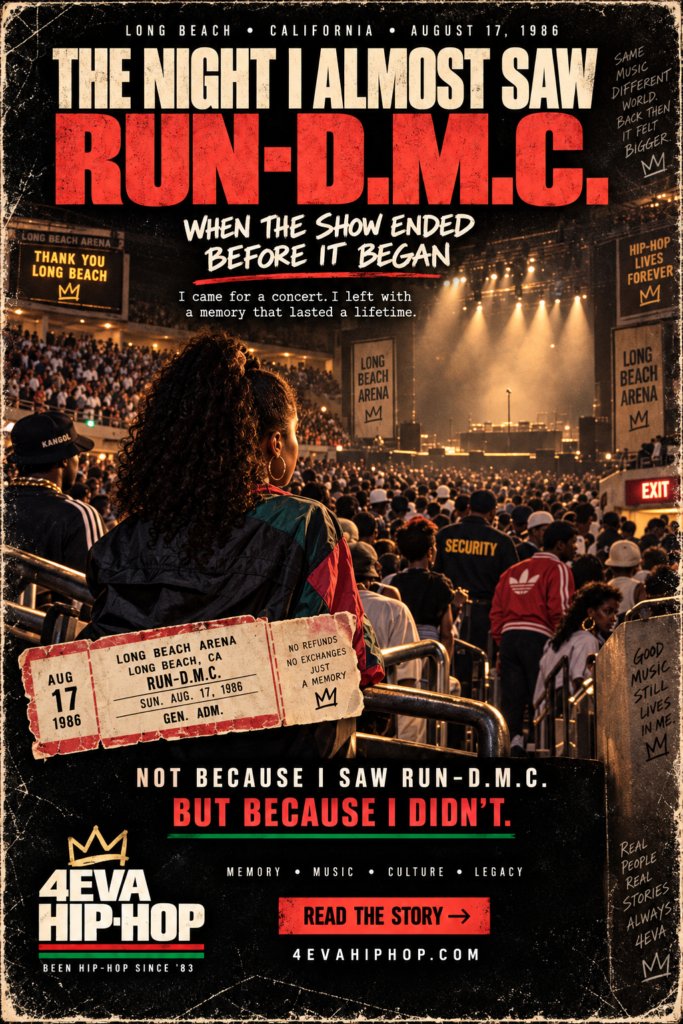
On August 17, 1986, I arrived at Long Beach Arena expecting to see Run-D.M.C.’s Raising Hell Tour. Instead, I witnessed a night that would stay with me for decades — not because the group performed, but because they never took the stage.
I was sixteen years old, standing among thousands of fans eager to see one of hip-hop’s biggest acts. In an era before social media and endless online clips, concerts felt larger than life. For a kid who had grown up listening to hip-hop on KDAY through the crackle of a bedroom radio, this wasn’t just another show — it was a chance to see artists who helped define the music and culture I loved.
And what a lineup it was.
Timex Social Club. Beastie Boys. LL Cool J. Whodini. Run-D.M.C.
Looking at those names together nearly forty years later feels extraordinary. But at sixteen, I wasn’t thinking about witnessing hip-hop history.
This was simply our music.
Walking into the arena felt like stepping into the center of the hip-hop universe. Fans filled the building in spotless Adidas sneakers, Kangol hats tilted just right, thick gold chains catching the arena lights, and fresh tracksuits in bright colors. Conversations, laughter and music blended into a steady roar, while the scent of popcorn and soda hung in the air.
Everything pointed toward an unforgettable night.
And in many ways, it was.
Just not for the reasons anyone expected.
The Night Begins
Before Run-D.M.C. was scheduled to take the stage, we had already experienced an incredible night of hip-hop.
I saw Timex Social Club, Beastie Boys and LL Cool J perform.
Today, I can look at those names and understand how remarkable that lineup was. Back then, I wasn’t thinking about where these artists would eventually stand in music history.
I was sixteen.
I was at a hip-hop concert.
And I was loving every minute of it.
Then came Whodini.
They were the act immediately before Run-D.M.C.
The crowd was locked in from the moment they hit the stage.
Colored spotlights swept across the arena while strobes flashed with the rhythm. Whodini commanded the stage, their voices booming through the speakers as the bass rolled through the floor and into my chest.
Fans danced, waved their arms overhead and sang along.
And somewhere underneath all that excitement was another layer of anticipation.
We knew who was supposed to come next.
Run-D.M.C.
But Whodini would never get the chance to finish their set.
Then Everything Changed
While Whodini was still performing, violence erupted in the audience.
What initially seemed like a disturbance quickly became something much larger.
The energy changed.
The focus shifted away from the music and toward what was happening throughout the arena.
Whodini tried to intervene, urging people to stop the violence so the concert could continue.
Sadly, it didn’t.
What had started as a celebration of music became something frightening.
I saw some of the most horrific imagery of my young life as gang members ran throughout the arena and surrounding areas, inciting violence and spreading fear.
Security rushed into action.
People stood on seats trying to understand what was happening.
Friends pulled one another closer.
Others hurried away from the disturbances.
The cheers that had filled the building were replaced by nervous shouting, whistles and the anxious roar of thousands of voices.
At sixteen, I wasn’t thinking about statistics.
I wasn’t thinking about what the newspapers would report the next morning.
I was inside it.
And I was scared.
Sadly, we never got to see the end of Whodini’s set.
The show was shut down.
And the group we had been waiting for all night never got started.
Run-D.M.C. never took the stage.
Sixteen and Disappointed
I remember feeling disappointed.
How could I not?
I had come to see one of my favorite groups.
I had imagined hearing those songs live. I had imagined watching Run and D.M.C. walk onto that stage. I had imagined leaving the arena with another great concert memory.
Instead, we were trying to get out safely.
Thankfully, we did.
And one of the memories that has stayed with me most happened after we made it outside.
I remember sitting on the curb, waiting for our parents to pick us up.
All that chaos had just happened.
We had witnessed things no sixteen-year-old expects to encounter at a concert.
Whodini’s performance had been cut short.
The entire show had been shut down.
And yet, sitting on that curb, part of me was still thinking:
I can’t believe I didn’t get to see Run-D.M.C.
Looking back now, there’s something almost innocent about that disappointment.
But that’s sixteen.
That’s being a fan.
I couldn’t possibly understand what that night would eventually represent.
I just knew the performance I had been waiting for never happened.
What I Remember Most
For years, I remembered that night primarily because of what went wrong.
But getting older changes the way you look at your memories.
Today, I can also appreciate what I did experience.
I saw Timex Social Club.
I saw Beastie Boys.
I saw LL Cool J.
I saw Whodini perform until the violence brought their set — and eventually the entire concert — to an end.
I was there.
And that’s what has become increasingly meaningful to me.
When I started revisiting these memories for Been Hip-Hop Since ’83, I began realizing that so many moments I once thought of simply as parts of my childhood and teenage years were happening alongside a culture that was transforming before our eyes.
I wasn’t studying hip-hop history.
I was living it.
The Night Didn’t End at Long Beach Arena
I would eventually learn that what happened that night became much bigger than the experience I carried home with me.
The violence at Long Beach became part of a broader conversation surrounding hip-hop, gangs, concert security and the way the culture itself was being perceived.
Run-D.M.C. faced questions about violence surrounding rap concerts even though the group never got the opportunity to perform that night.
But one part of the aftermath feels particularly meaningful to me now.
Because somehow, KDAY found its way back into the story.
KDAY Was There Again
KDAY had already been part of my hip-hop story for years.
1580 on the AM dial.
Southern California.
The radio.
Waiting for songs.
The station that helped introduce me to a culture that would remain part of my life for decades.
Then, after Long Beach, KDAY became part of this story too.
Run-D.M.C. later joined Barry White and community leaders on KDAY for a Day of Peace, using the radio station to speak directly to young people about gang violence.
I didn’t make that connection at sixteen.
I wouldn’t have.
But looking back now, the connection feels almost full circle.
The station that helped introduce me to hip-hop became part of the response to one of the most frightening nights I experienced as a young hip-hop fan.
KDAY was there at the beginning of my story.
And somehow, it was there again.
Then, Nearly Forty Years Later…
And then something happened recently that stopped me in my tracks.
I was watching HBO’s new JAŸ-Z IN 8, listening to Jay-Z and Rick Rubin talk about music and hip-hop history.
Then I heard Rick Rubin reference the Run-D.M.C. concert in Long Beach.
I froze.
Wait.
That Long Beach concert?
The concert I attended?
Suddenly, I wasn’t sitting in 2026 anymore.
I was sixteen again.
I could see Long Beach Arena.
I could remember the crowd.
Whodini.
The confusion.
The fear.
Sitting outside afterward waiting for our parents.
And that overwhelming disappointment that Run-D.M.C. had never taken the stage.
That concert.
The one I had carried around in my memory for almost forty years.
Rick Rubin’s connection made hearing it particularly powerful for me. He wasn’t simply someone looking backward at the era. He was part of the musical world surrounding Run-D.M.C. and Raising Hell, including the groundbreaking collaboration with Aerosmith on “Walk This Way.”
And here I was, almost four decades later, hearing him refer to a night that sixteen-year-old me had simply experienced.
That’s when something clicked.
We Don’t Always Know We’re Standing Inside History
That’s one of the things Been Hip-Hop Since ’83 is teaching me.
We don’t always recognize history when we’re standing inside it.
Sometimes history looks completely ordinary.
A school bus.
A bedroom radio.
A blank cassette tape.
A concert ticket.
A sixteen-year-old girl getting ready to see her favorite artists.
At the time, I wasn’t documenting hip-hop.
I wasn’t thinking about archives.
I wasn’t wondering what these artists would mean forty years later.
I wasn’t imagining documentaries.
I was living my life.
That’s all.
And maybe that’s what makes personal memories like these worth preserving.
The historical record can document what happened.
But it can’t tell you what it felt like to be sixteen years old inside that arena.
It can’t tell you what it felt like when the energy changed.
It can’t recreate sitting on that curb afterward.
And it certainly can’t explain why, after everything that had happened, I was still thinking:
I can’t believe I didn’t get to see Run-D.M.C.
Sometimes history doesn’t announce itself.
Sometimes history just feels like Saturday night.
Not Because I Saw Run-D.M.C.
For most of my life, August 17, 1986, was simply the night I almost saw Run-D.M.C.
Now I understand it differently.
I understand that I witnessed an incredible lineup of artists.
I understand that the violence I experienced became part of a much larger conversation about hip-hop.
I understand the connection that eventually brought KDAY back into the story.
And almost forty years later, I can hear Rick Rubin mention that same Long Beach concert and say:
I was there.
But underneath all of that history is still a very simple memory.
I was sixteen years old.
I loved hip-hop.
I went to Long Beach Arena expecting to see one of my favorite groups.
I saw Timex Social Club.
I saw Beastie Boys.
I saw LL Cool J.
I watched Whodini take the stage.
Then I watched the night unravel before Whodini could even finish.
We made it outside safely.
I sat on a curb waiting for our parents to pick us up.
And after everything that had happened, sixteen-year-old me was still disappointed that Run-D.M.C. never came out.
Maybe that’s why the memory has stayed with me all these years.
Not because everything went according to plan.
Because nothing did.
I came for a concert.
I left with a memory that lasted a lifetime.
Not because I saw Run-D.M.C.
But because I didn’t.
Sometimes the moments that shape us aren’t the ones we planned for. They’re the ones that stay with us long enough for us to finally understand what they meant.
A Note on Memory & History
Been Hip-Hop Since ’83 is rooted in my personal memories of growing up with hip-hop in Southern California. The historical context came later.
Contemporary reporting documented the violence surrounding the August 17, 1986 concert at Long Beach Arena and confirmed that the show ended before Run-D.M.C. could perform. In the aftermath, Run-D.M.C., Barry White and community leaders participated in a KDAY “Day of Peace” broadcast addressing gang violence.
Nearly forty years later, the memory came rushing back while I was watching HBO’s JAŸ-Z IN 8 and heard Rick Rubin reference the Run-D.M.C. concert in Long Beach — the same concert I attended at sixteen.
Sources & Further Reading: Los Angeles Times archival coverage of the 1986 Long Beach concert, its aftermath and KDAY’s “Day of Peace”; HBO’s JAŸ-Z IN 8.
BEEN HIP-HOP SINCE ’83
Some memories aren’t captured on a phone. They’re carried with you.
4EVA HIP-HOP
This is my love letter to the culture.
Respect the Past. Build the Future.
Keep Going
Join 4EVA →
Pingback: Why KDAY Was Our Spotify – 4EVA HIP-HOP