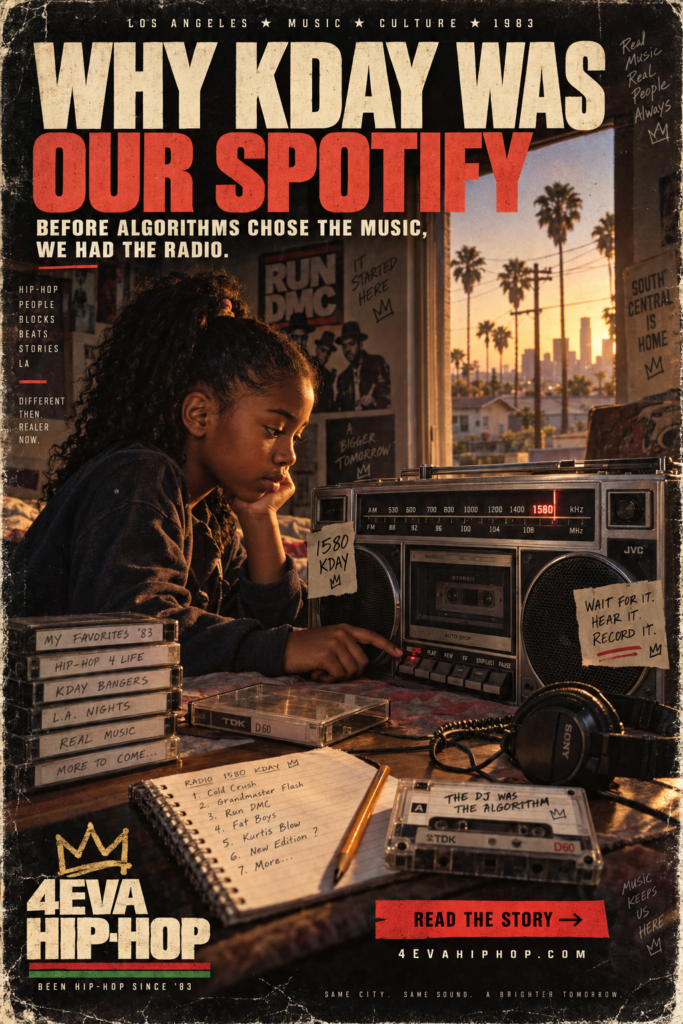
Been Hip-Hop Since ’83
Before Algorithms Chose the Music, We Had the Radio
Before Spotify knew what you liked.
Before YouTube could recommend what to play next.
Before you could hear almost any song in seconds.
We had the radio.
And growing up in Southern California, one station became an important part of my introduction to hip-hop: 1580 KDAY.
Today, discovering music is almost effortless. Type an artist’s name, press play, and an entire catalog appears. If you like a song, you can save it instantly. If you want to hear it again, you can play it ten times in a row.
But in the early days of my relationship with hip-hop, discovering music required something different.
You had to listen.
And sometimes, you had to wait.
When Waiting Made the Music Better
There was something exciting about hearing a song on the radio that you loved. The problem was, you couldn’t immediately play it again.
There was no replay button.
No saved library.
No “Recently Played.”
No algorithm waiting to serve you another song just like it.
If your favorite record came on, whatever you were doing suddenly became less important.
That was your moment.
Turn it up.
Listen.
Remember it.
And hope the DJ told you who it was.
Sometimes you might hear the song again an hour later. Sometimes you waited for hours. Sometimes you didn’t hear it again until the next day.
That anticipation created a relationship with music that’s difficult to explain in the streaming era.
And for my brother and me, waiting for those songs became part of the experience.
The Original “Add to Playlist”
My brother and I would sometimes sit near the radio for hours waiting for one of our favorite songs to come on KDAY.
And we were ready.
There would be a blank cassette tape loaded into the deck, because when that song finally came through the speakers, there wasn’t time to waste.
You couldn’t search for it.
You couldn’t ask KDAY to play it on demand.
You couldn’t pull out your phone and find it somewhere else.
You just had to listen.
And wait.
Then we’d hear those opening seconds.
That’s it.
And suddenly — RECORD.
You had to hit that button fast.
Sometimes we caught the song perfectly from the beginning. Sometimes we missed the first few seconds. Sometimes the DJ was still talking over the intro. Sometimes the radio reception wasn’t perfect.
It didn’t matter.
We had the song.
And then we’d do it again. And again.
Song by song, cassette by cassette, my brother and I eventually gathered enough tapes filled with the music we loved that we had created our own collection.
Looking back now, I realize those cassettes were essentially our playlists. Except nobody built them for us. No software studied our listening habits. No algorithm suggested what should come next.
We made them ourselves.
Every song had to be discovered.
Waited for.
Recorded.
Collected.
And remembered.
Today, I can tap a heart or click “Add to Playlist” in seconds. Back then, adding one song to your collection might take all afternoon.
And somehow, finally getting it made the song feel even more special.
The DJ Was the Algorithm
Today, technology recommends music based on everything we’ve listened to before. Back then, the DJ did something remarkably similar — but with a human touch.
DJs weren’t simply pressing play.
The best ones had taste.
Personality.
Knowledge.
Timing.
They could introduce you to an artist you’d never heard before and make you want to know more. They connected artists to audiences. They helped records travel. They created excitement around songs.
And radio gave us something streaming sometimes struggles to recreate: a shared moment.
Thousands of people could be listening to the same record at the same time. You weren’t alone with your personalized feed. Somewhere across Southern California, other people were hearing exactly what you were hearing.
And the next day, people talked about it. That collective experience helped create culture.
Why KDAY Mattered
For me, growing up in Southern California while hip-hop was still expanding, KDAY wasn’t simply background noise.
It was access.
It was discovery.
It was education.
It connected me to a sound and a culture that were becoming part of my life.
Today, hip-hop is everywhere. You can find decades of music within seconds. You can watch performances, interviews and documentaries from practically anywhere. Artists can reach audiences directly from their phones.
Back then, finding hip-hop could feel like finding your thing.
Something new.
Something exciting.
Something that belonged to a generation developing its own musical language.
And KDAY helped bring that world through the speakers.
Before We Followed Artists, We Followed Stations
Today, we follow individual artists. We follow their social accounts. We watch their videos. We stream their catalogs. We receive notifications when they release new music.
Radio created a different relationship.
You trusted the station.
You tuned in because you knew there was a chance you’d hear something you loved — or discover something you hadn’t heard before. You didn’t always know what was coming next. That was part of the excitement.
Radio wasn’t simply distributing music.
It was curating culture.
And for hip-hop, that mattered.
KDAY Was Our Spotify
When I say “KDAY Was Our Spotify,” I say it with affection.
Obviously, the experiences weren’t identical. Spotify gives us instant access to more music than my brother and I could have imagined while sitting there waiting with those cassette tapes. And I appreciate that.
But KDAY served a similar emotional purpose in my life.
It helped me discover.
It introduced me to artists.
It gave me songs to chase.
It gave me music to record.
It gave my brother and me something to wait for.
And eventually, it helped us build a music collection of our own.
Most importantly, it became part of my memories.
There was something beautifully human about not knowing what song was coming next.
You couldn’t skip.
You couldn’t shuffle.
You couldn’t ask an algorithm for more of the same.
You simply turned on the radio and entered the experience.
Some Things an Algorithm Can’t Recreate
Technology has made music more accessible. That’s a wonderful thing. I wouldn’t trade the ability to instantly revisit the music I’ve loved throughout my life.
But convenience changed the ritual.
Sometimes I think about my brother and me waiting beside that radio, cassette ready, hoping KDAY would finally play the song we wanted.
The anticipation.
Listening for those first few notes.
Realizing this is it.
Reaching for RECORD.
And that little sense of victory when we caught it.
We don’t have to do that anymore. We don’t have to sit beside the radio waiting for hours. We don’t have to scramble for a blank cassette. We don’t have to hope the DJ tells us who we’re listening to.
And perhaps that’s exactly why those memories remain so powerful.
We had to participate in discovering the music.
Those weren’t just cassette tapes.
They were our playlists before we even had a word for playlists.
Before Spotify, We Had KDAY
For me, 1580 KDAY will always represent that period.
A radio dial.
A school bus.
My brother.
A cassette tape waiting in the deck.
A song you hoped would come on.
A finger ready to hit RECORD.
And a culture becoming part of who I was before I even realized it.
More than four decades later, I can ask an app to play almost any song I can remember. But there was something unforgettable about a time when the music made us wait for it.
Because when that song finally came through those speakers? You listened.
So when someone asks how we discovered hip-hop before streaming, my answer is simple:
Before the algorithm, we had the DJ.
Before the playlist, we had the cassette.
Before Spotify, we had KDAY.
BEEN HIP HOP SINCE ’83
Some of us didn’t discover hip-hop through an algorithm. We found it on the dial.
4EVA HIP-HOP
This is my love letter to hip-hop.
Respect the Past. Build the Future.
Next Story
The Night I Almost Saw Run-D.M.C. →
Pingback: Born on a School Bus: How Hip-Hop Found Me – 4EVA HIP-HOP